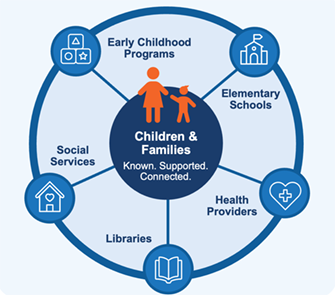
For many families, kindergarten is when the gaps among the systems supporting a young child become impossible to ignore. By then, children may already have relationships with early childhood educators, health providers, libraries, and other community organizations. When those institutions are not connected, families may have to start over, educators...
A chief benefit of blogs is the interactive dialogue they can support. With the Birth–3rd Learning Hub, I have an opportunity to test ideas with people who are deeply involved in doing Birth–3rd work. A...
Does your partnership sometimes “go wide” before focusing in on concrete strategies? For a helpful toolkit on designing new strategies, initiatives, and/or programs, see Design Thinking for Educators by the renowned design firm IDEO. Thanks...
The National Association of Elementary School Principals has published an ambitious vision of the principal’s role in PreK–3rd reform. This report, Leading Pre-K-3 Learning Communities: Competencies for Effective Principal Practice, outlines six competencies that together...
While most of the country’s obsessive politics-watchers will be surveying a variety of hotly contested Senate, House, and gubernatorial races on November 4, the early education community will have an eye trained on Seattle, Washington....
In last week’s post I showed how the work of Massachusetts’ Birth—3rd partnerships is “spilling over” in unexpected and promising ways due to the creation of new social and institutional relationships. These spillovers illustrate how...
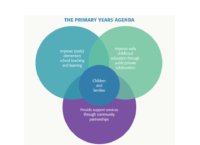
Kappan Magazine has just published an article I wrote , The Primary Years Agenda: Strategies to Guide District Action. I draw on examples from Massachusetts and other states to make the case for three Birth-3rd...