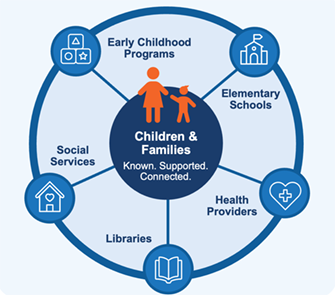
For many families, kindergarten is when the gaps among the systems supporting a young child become impossible to ignore. By then, children may already have relationships with early childhood educators, health providers, libraries, and other community organizations. When those institutions are not connected, families may have to start over, educators may lack important context about children, and the transition into school can become harder than it needs to be.
Two publications released this month examine how school–early childhood zones and hubs can help communities build continuity from the earliest years into elementary school.
What the research tells us
Strong Communities, Thriving Children: The Power of School–Early Childhood Zones and Hubs to Drive Change, published by the Stanford Center on Early Childhood, reviews four converging strands of research. Together, they point to the importance of starting early, taking place seriously, strengthening social cohesion, and creating greater continuity across the early years.
The paper examines how early childhood programs and schools can help families form relationships, connect with resources, and develop a stronger sense of belonging. It includes examples of communities putting these ideas into practice by aligning systems and practices, jointly implementing strategies for children and families, and building cross-sector communities of practice for early years educators.
A zone brings together multiple elementary schools, early childhood providers, and community partners within a defined geography. A hub centers similar work around one elementary school and the early childhood programs and services connected to it. Neither is a new program. Both provide infrastructure that helps existing institutions work together more effectively.
A call to action
The shorter Capita publication, Transforming Communities through School–Early Childhood Zones and Hubs: A Call to Action, focuses on what communities and leaders should do next. It argues that zones and hubs address a critical gap: strong programs often operate nearby without the structures needed to coordinate their work.
The paper calls on school districts to partner with early childhood providers and community organizations before kindergarten. It calls on policymakers and funders to invest not only in individual programs, but also in the infrastructure that connects them. And it calls on communities to organize around shared geography and shared responsibility for children and families.
In First 10 communities, these connections take many forms: early childhood and kindergarten educators sharing information and learning together; schools, libraries, and community organizations offering play-and-learn opportunities; family navigators helping families access services; and partners coordinating transition-to-kindergarten activities. These strategies can improve continuity for children, build trust with families, and strengthen relationships among the institutions that serve them.
Starting earlier and working together
Schools already think across transitions in many parts of the education system. The connection between early childhood and elementary school, however, remains underdeveloped. Zones and hubs create a practical structure for schools to work with early childhood providers and community partners before children enter kindergarten.
This is not about asking schools to do everything. It is about helping the institutions already serving children and families work together more intentionally. When they do, communities can make better use of their existing resources, support families earlier, and create more connected pathways for children from the earliest years into elementary school.
We hope these publications contribute to a growing conversation about how communities can organize their relationships, resources, and institutions so that all children and families can learn and thrive.