


In this EdSurge interview, David Jacobson shares insights about how a more connected approach to the Transition to Kindergarten can help young children navigate this major shift.
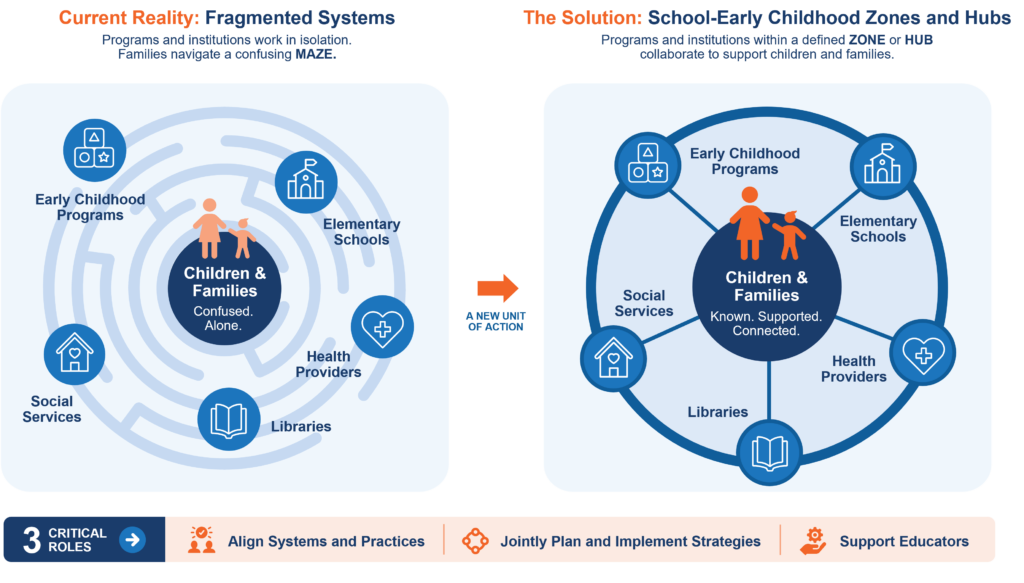
This Capita article describes school-early childhood zones and hubs and how they function as close-to-the-ground, family-focused partnerships that enable three forms of action that rarely occur together otherwise:
Zones and hubs are not new programs. They are new infrastructure, the connective tissue that allows existing programs to function as a system rather than a collection of parts.
This two-page flyer gives an overview of the First 10 approach to improving outcomes for children ages 0-10.
This study examines First 10 Schools and Communities—coordinated efforts taking place around the country to improve teaching, learning, and care during the first decade of children’s lives. First 10 Schools and Communities bring together school districts, elementary schools, and early childhood programs to improve the quality of education and care for young children and their families. They work to improve teaching and learning, deepen partnerships with families, and provide comprehensive services for children and families. First 10 initiatives take two basic forms: First 10 School Hubs are anchored by a single elementary school, which provides direct support to families and collaborates with nearby early childhood providers. First 10 Community Partnerships bring together multiple elementary schools, school district leaders, and early childhood programs to improve the quality and coordination of early childhood education and care throughout a geographic area or community.